solar/energy storage systems installation guidlines
SOLAR - Applicable Code Sections
-
Emergency power systems and standby power systems shall be installed in accordance with the California Building Code, California Electrical Code, NFPA 110 and NFPA 111.
-
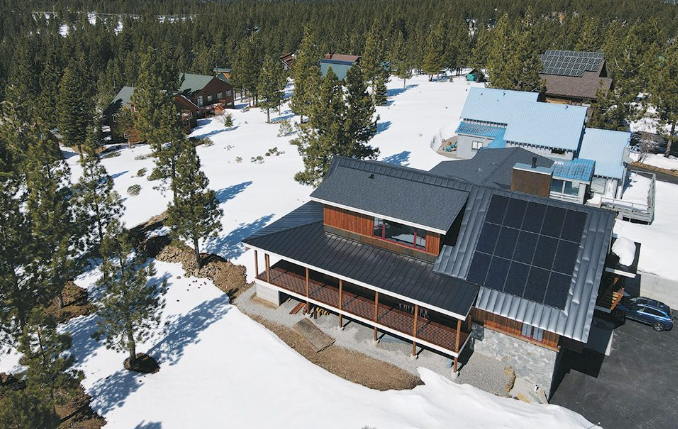
Roof access, pathways and spacing requirements shall be provided in accordance with Sections 1205.2.1 through 1205.3.3. Pathways shall be over areas capable of supporting firefighters accessing the roof. Pathways shall be located in areas with minimal obstructions, such as vent pipes, conduit or mechanical equipment.
1205.2.1.1 Pathways to ridge. Not fewer than two 36-inch-wide (914 mm) pathways on separate roof planes, from lowest roof edge to ridge, shall be provided on all buildings. Not fewer than one pathway shall be provided on the street or driveway side of the roof. For each roof plane with a photovoltaic array, not fewer than one 36-inch-wide (914 mm) pathway from lowest roof edge to ridge shall be provided on the same roof plane as the photovoltaic array, on an adjacent roof plane or straddling the same and adjacent roof planes.
1205.2.1.2 Setbacks at ridge. For photovoltaic arrays occupying 33 percent or less of the plan view total roof area, a setback of not less than 18 inches (457 mm) wide is required on both sides of a horizontal ridge. For photovoltaic arrays occupying more than 33 percent of the plan view total roof area, a setback of not less than 36 inches (457 mm) wide is required on both sides of a horizontal ridge.
-
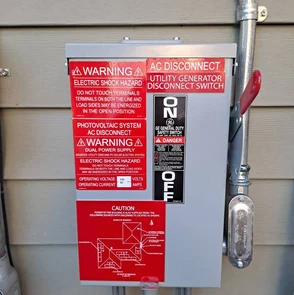
Where emergency or standby power is provided at a structure, an electrical shunt trip/switch shall be provided in accordance with Section 509.2.1.
Where a facility is provided with more than one electrical power supply, the rapid shutdown switch shall be interconnected to, or within 3 feet (914 mm) of, the electrical shunt trip/switch in accordance with Section 509.2.1. The rapid shutdown switch and the remote electrical shunt trip/switch, if provided, shall have a label located not greater than 3 feet (914 mm) from the switch that states the following: “RAPID SHUTDOWN SWITCH FOR SOLAR PV SYSTEM.”
-
New structures and remodeled structures shall be provided with a remote main power electrical shunt switch in an approved location where any of the following conditions occur:
The main power disconnect switch is located on the interior of a building,
The main power disconnect switch is inaccessible to fire department personnel due to location or to climatic conditions, or
The facility is equipped with multiple electrical sources, such as fuel cells, ESS, generators or solar photovoltaic systems.
Exception: Facilities where the Fire Code Official determines the electrical shunt trip/switch is not required.
The remote main power electrical shunt trip/switch shall be hard wired to all power sources. The electrical shunt trip/switch shall be installed on the exterior of the building in a location approved by the Fire Code Official and protected from the elements. The electrical shunt trip/switch shall have an approved, permanent, weatherproof sign which states “MAIN POWER SHUNT TRIP/SWITCH.”
ENERGY STORAGE SYSTEMS - Applicable Code Sections
-
Stationary and mobile ESS shall comply with the requirements of Sections 1207.4.1 through 1207.4.12.
-
Where the ESS disconnecting means is not within sight of the main electrical service disconnecting means, placards or directories shall be installed at the location of the main electrical service disconnecting means indicating the location of stationary storage battery system disconnecting means in accordance with the California Electrical Code.
Exception: Electrical disconnects for lead-acid and nickel-cadmium battery systems at facilities under the exclusive control of communications utilities and operating at less than 50 VAC and 60 VDC shall be permitted to have electrical disconnects signage in accordance with NFPA 76.
-
ESS in group R-3 and R-4 occupancies shall be in accordance with Sections 1207.11.1 through 1207.11.9.
1207.11.2 Installation. ESS shall be installed in accordance with the manufacturer’s instructions and their listing.
1207.11.2.1 Spacing. Individual ESS units shall be separated from each other by at least 3 feet (914 mm) except where smaller separation distances are documented to be adequate based on large-scale fire testing complying with Section 1207.1.7.
1207.11.3 Location. ESS shall be installed only in the following locations:
Detached garages and detached accessory structures.
Attached garages separated from the dwelling unit living space in accordance with Section R302.6.
Outdoors or on the exterior side of exterior walls located not less than 3 feet (914 mm) from door and windows directly entering the dwelling unit.
Enclosed utility closets, basements, and storage or utility spaces within dwelling units and sleeping units with finished or noncombustible walls and ceilings. Walls and ceilings of unfinished wood-framed construction shall be provided with not less than 5/8-inch (15.9 mm) Type X gypsum wallboard.
ESS shall not be installed in sleeping rooms, or in closets or spaces opening directly into sleeping rooms.
1207.11.6 Fire detection. ESS installed in Group R-3 and R-4 occupancies shall comply with the following:
Rooms and areas within dwelling units, sleeping units, basements and attached garages in which ESS are installed shall be protected by smoke alarms in accordance with Section 907.2.11.
A listed heat alarm shall be installed in locations where smoke alarms cannot be installed based on their listing.
-
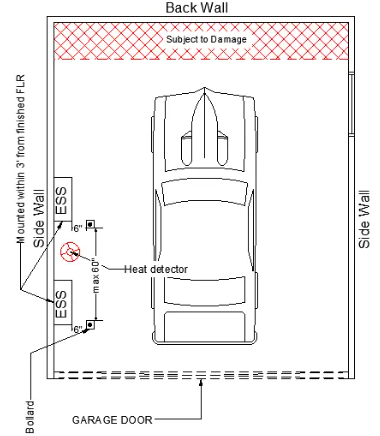
ESS installed in a location subject to vehicle damage in accordance with Section 1207.11.7.1 or 1207.11.7.2 shall be provided with impact protection in accordance with Section 1207.11.7.3.
1207.11.7.1 Garages. Where an ESS is installed in the normal driving path of vehicle travel within a garage, impact protection complying with Section 1207.11.3 shall be provided. The normal driving path is a space between the garage vehicle opening and the interior face of the back wall to a height of 48 inches (1219 mm) above the finished floor. The width of the normal driving path shall be equal to the width of the garage door opening. Impact protection shall also be provided for an ESS installed at either of the following locations:
On the interior face of the back wall and located within 36 inches (914 mm) to the left or to the right of the normal driving path.
On the interior face of a side wall and located within 24 inches (610 mm) of the back wall and 36 inches (914 mm) of the normal driving path.
Exception: Where the clear height of the vehicle garage opening is 7 feet 6 inches (2286 mm) or less, ESS installed not less than 36 inches (914 mm) above the finished floor are not subject to vehicle impact protection requirements.